Table of Contents
- How Trackman 4 Improves Golf Swing: The Fundamentals
- Understanding TrackMan 4 Swing Data for Better Decisions
- Using TrackMan 4 Swing Videos to Diagnose Your Faults
- Golf Swing Speed Training With Trackman 4 Metrics
- Step-by-Step: Your First Trackman 4 Session
- Building a Data-Driven Practice Routine
- Common Mistakes to Avoid With Trackman 4
- Turning Trackman 4 Insights Into Lower Scores
- Frequently Asked Questions
Last Updated: October 12, 2026
How Trackman 4 Improves Golf Swing: The Fundamentals
Trackman 4 improves golf swing performance by delivering precise, real-time data on every shot. Instead of guessing what your swing is doing, you see exactly what happens at impact, transforming practice from feel-based to fact-based.
At Major Golf Direct, we use Trackman 4 in our private custom fitting studios to help golfers of all levels understand their swing DNA.
What Trackman 4 Measures at Impact
Trackman 4 measures club data and ball data simultaneously at the moment of impact. Club data includes club head speed, club path, and face angle.
These measurements matter because impact decides everything: a tiny difference in face angle or club path changes where the ball goes.
The system also measures smash factor, ball speed divided by club speed, which shows how efficiently you transfer energy from club to ball.
Why Ball Flight Data Reveals Hidden Swing Issues
Your ball flight tells a story about your swing mechanics. A slice, for example, is not a mystery.
Trackman 4 shows you exactly which factor is causing the miss, an open face angle, a club path too far right, or both, so you can fix the actual problem instead of guessing.
Many golfers practice the wrong fix because they misdiagnose the cause. Trackman 4 removes the guesswork.
Understanding TrackMan 4 Swing Data for Better Decisions
Trackman 4 swing data gives you the information you need to make smart practice choices, but only if you understand what the numbers mean and how to use them.
Club Path and Face Angle: The Core of Consistency
Club path is the direction your club head is moving through impact. Face angle is the direction the club face is pointing.
When your club path and face angle are aligned, you hit straight shots. When they diverge, you hit curves.
Understanding this relationship is the foundation of consistency. You can't fix what you don't measure. Trackman 4 swing videos combined with impact data show you exactly what's happening.
Launch Angle, Spin Rate, and Shot Shape
Launch angle is how high the ball leaves the club face. Spin rate is how fast the ball is spinning. Together, these numbers determine trajectory and distance.
A high launch angle with low spin produces a high, floating shot; a low launch angle with high spin produces a boring, penetrating shot.
For wedges, spin rate is critical: more spin means the ball stops faster on the green.
Smash Factor and Strike Location
Smash factor tells you how efficiently you're hitting the ball. A driver typically produces a smash factor of around 1.48 to 1.50.
Strike location shows where on the club face you made contact. Centre strikes produce the highest smash factor; toe or heel strikes reduce it.
Many golfers think they're making solid contact when they're actually missing the sweet spot. Trackman 4 shows the exact location of every strike, making it invaluable for consistency.
Using TrackMan 4 Swing Videos to Diagnose Your Faults
Trackman 4 swing videos give you visual feedback alongside the numbers, revealing mechanics that feel invisible during the swing itself.
Comparing Feel to Data: Why Your Perception May Be Wrong
Your perception of your swing is often inaccurate: you feel like you're swinging left when you're actually swinging right, or making solid contact when you're hitting the toe.
This is normal. The human body is not a reliable judge of its own motion. Trackman 4 swing videos solve this problem by showing you exactly what's happening.
This feedback loop is powerful: once you see the truth, you can make real changes.
High-Speed Footage and Visual Feedback
Trackman 4 captures swing video at high speed, revealing details invisible at normal speed: club face rotation, lag angle, and swing sequence.
Many golfers benefit from seeing their swing in slow motion for the first time, early extension, casting, or loss of lag become obvious, so you can fix these specific mechanics.
Golf Swing Speed Training With Trackman 4 Metrics
Increasing club head speed adds distance. Trackman 4 measures club speed accurately and tracks whether your training is working.
Measuring Club Speed and Smash Factor Consistently
Club head speed is measured in miles per hour. Trackman 4 records every swing, so you can see trends over time.
Smash factor becomes even more important when training for speed. Gaining 5 mph of club speed only helps if you maintain or improve your smash factor; if it drops, you're not hitting the centre of the face and won't see the distance gains you expect.
Track both numbers in every session. Speed without efficiency is wasted effort.
Building a Speed-Development Practice Plan
A speed-development plan focuses on generating more club head speed while maintaining contact quality. This requires targeted practice, not just harder swings.
Many golfers benefit from weighted clubs or swing trainers, and Trackman 4 lets you measure whether they actually work by comparing club speed before and after a speed-training block.
The key is consistency. One fast swing doesn't matter. A pattern of increasing club speed over weeks and months does.
Step-by-Step: Your First Trackman 4 Session
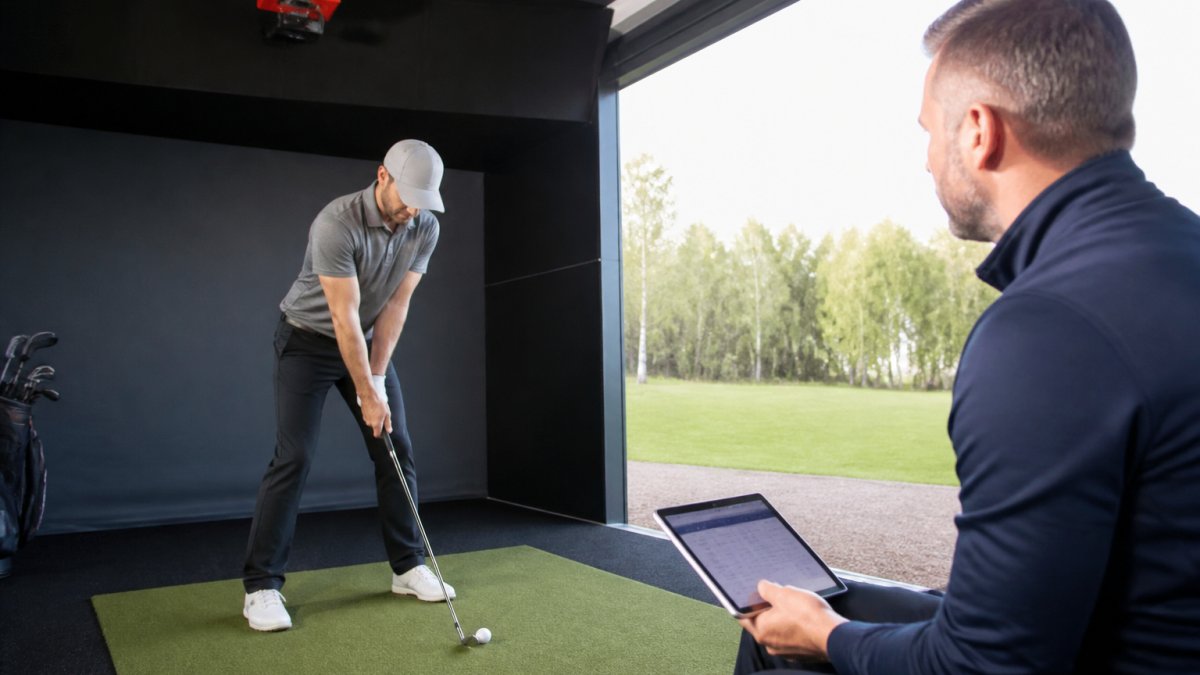
Your first Trackman 4 session at Major Golf Direct follows a clear structure. Understanding what to expect helps you get the most from it.
What to Expect During Setup and Calibration
Your PGA Professional will position you at the hitting station and calibrate the Trackman 4 system. This takes a few minutes and ensures accurate readings.
You'll hit a few warm-up shots while the system confirms it's tracking correctly. The PGA Professional will adjust your position if needed to optimise the data capture.
This setup phase is important. Poor calibration produces poor data. A few minutes of precision at the start saves time later.
Taking Baseline Measurements
Your first shots establish your baseline. These numbers become your reference point for measuring improvement.
Hit a series of shots with your driver, mid-irons, and wedges. The PGA Professional will record data for each club. This gives a complete picture of your current performance.
Don't try to swing perfectly. Swing normally. The goal is to capture your typical swing, not your best swing.
Interpreting Your Data Report
Your data report shows averages and ranges for each metric. You'll see your average club speed, ball speed, launch angle, and spin rate for each club.
The PGA Professional will walk you through the report and explain what the numbers mean. They'll identify patterns and areas for improvement.
This is where the real value emerges. The numbers tell a story about your swing. Understanding that story guides your practice.
Building a Data-Driven Practice Routine
Trackman 4 data only matters if you use it to guide your practice. A data-driven routine focuses your effort on the areas that will improve your scores.
Structuring Sessions by Skill Level
A beginner focuses on consistency and solid contact. Your practice sessions should emphasise strike location and smash factor.
An intermediate golfer focuses on shot shape control. Your sessions should track club path and face angle relationships.
An advanced golfer focuses on fine-tuning distance control and managing miss patterns. Your sessions should measure dispersion and compare feel to data.
Structure your practice around your current level.
Avoiding Overreaction to Noisy Readings
Trackman 4 data is accurate, but individual shots vary. One swing with a poor smash factor doesn't mean your contact is broken.
Look for patterns, not single data points. If your average smash factor drops over a set of 10 shots, that's meaningful.
This is where many golfers make mistakes. They overreact to a single bad shot and change their swing unnecessarily. Patience and pattern recognition matter more than reacting to noise.
Tracking Progress and Confirming Changes On Course
Trackman 4 data shows improvement in the studio. But the only score that matters is the one on the course.
Use your Trackman 4 data to predict on-course improvement. If your club head speed increased by 5 mph and your smash factor stayed consistent, you should hit the ball further.
Track your actual scores alongside your Trackman 4 data. This confirms whether your practice changes are working in real golf.
Metric |
What It Measures |
Why It Matters |
|---|---|---|
Club Speed |
How fast the club head is moving |
Directly affects distance |
Ball Speed |
How fast the ball leaves the club |
Determines carry distance |
Smash Factor |
Efficiency of energy transfer |
Higher is better for consistency |
Launch Angle |
How high the ball leaves the club |
Affects trajectory and distance |
Spin Rate |
How fast the ball is spinning |
Controls shot shape and stopping power |
Club Path |
Direction of club movement at impact |
Determines shot shape |
Face Angle |
Direction club face is pointing |
Determines shot direction |
Common Mistakes to Avoid With Trackman 4
Trackman 4 is a powerful tool, but misusing it can waste your time and frustrate your progress.
The biggest mistake is chasing numbers instead of golf improvement.
Another common mistake is changing your swing too much based on one or two sessions.
A third mistake is ignoring the role of course management.
Work with a PGA Professional who understands how to translate Trackman 4 data into practical swing changes.
Turning Trackman 4 Insights Into Lower Scores
The path from data to lower scores is straightforward. Identify your biggest weakness.
This approach works because it's specific and measurable. You're not guessing what to work on.
At Major Golf Direct, our PGA Professional staff use Trackman 4 in our private custom fitting studios to help you understand your swing DNA and build an improvement plan tailored to your game. Research from the R&A Golf Foundation confirms that data-driven instruction produces faster improvement than traditional methods.
We also stock a range of launch monitors to support your home practice.

Creating a complete practice environment is easier with the right equipment.
Book a fitting with our PGA Professionals today.
Frequently Asked Questions
Which Trackman 4 numbers should I focus on first to improve my golf swing?
Start with club path and face angle—these control shot direction and consistency. Then examine launch angle and spin rate, which determine distance and trajectory. Smash factor shows how efficiently you're transferring energy to the ball. Most golfers see immediate improvement by fixing one of these three areas. Your PGA Professional will help you prioritize based on your specific swing faults.
How can I tell if my Trackman 4 data is actually improving my on-course performance?
Track three metrics: club path consistency, dispersion pattern (how tightly your shots group), and average distance per club. Then play 9-18 holes and record fairways hit, greens in regulation, and total score. If your Trackman 4 data improves but scores don't, you may be overcomplicating your swing or not transferring practice changes to the course. Real improvement shows in both metrics and lower scores.
What if my Trackman 4 readings seem inconsistent shot to shot?
Small variations are normal—Trackman 4 is extremely sensitive and detects tiny differences in strike location and club path. If readings swing wildly, check setup consistency, ball position, and stance width. Ensure the unit is calibrated correctly at the start of your session. Take 10 shots before judging your baseline; ignore single outliers. If inconsistency persists, your PGA Professional can identify whether it's a measurement issue or a genuine swing inconsistency that needs addressing.
Can beginners benefit from Trackman 4, or is it only for advanced golfers?
Beginners benefit enormously because Trackman 4 removes guesswork. Instead of hearing vague advice like 'swing smoother,' you see exactly what your club is doing at impact. This clarity accelerates improvement. Our PGA Professionals explain metrics in straightforward terms—no technical jargon required. Many beginners make faster progress with data-driven feedback than with traditional lessons alone.
Lower scores start with understanding your actual swing. Trackman 4 reveals what you're really doing at impact, not what you think you're doing. Our PGA Professional team at Major Golf Direct uses this technology in our private fitting studios to build custom equipment solutions matched to your swing DNA. Book your session and discover how data-driven practice transforms your game.