Table of Contents
- Understanding What Causes Your Golf Slice
- How to Strengthen Your Golf Grip for Slice Prevention
- Check Your Alignment and Setup Position
- Fix Your Takeaway and Swing Path
- Best Driver Settings for Slice Correction
- Drills to Stop Slicing the Driver
- Self-Diagnosis Through Video Analysis
- Frequently Asked Questions
Last Updated: September 20, 2026
Understanding What Causes Your Golf Slice
A golf slice happens when the ball curves sharply to the right (for right-handed golfers). The cause is usually a club face that points right at impact, combined with an outside-in swing path. Understanding this is the first step to fixing golf slice issues consistently.
Most slices stem from grip weakness, poor alignment, or an incorrect swing path.
A weak grip opens the club face at impact. Poor alignment forces an outside-in swing path. Both compound the slice.
How to Strengthen Your Golf Grip for Slice Prevention
A strong grip is your foundation to fix golf slice problems. Position your hands so the V formed by your thumb and forefinger points toward your right shoulder (for right-handed golfers).
Here's how to build the correct grip:
- Hold the club in your fingers, not your palm
- Rotate both hands slightly clockwise
- The V between thumb and forefinger should point at your right shoulder
- Your left hand should show 2-3 knuckles when you look down
- Your right hand sits below the left, matching the angle
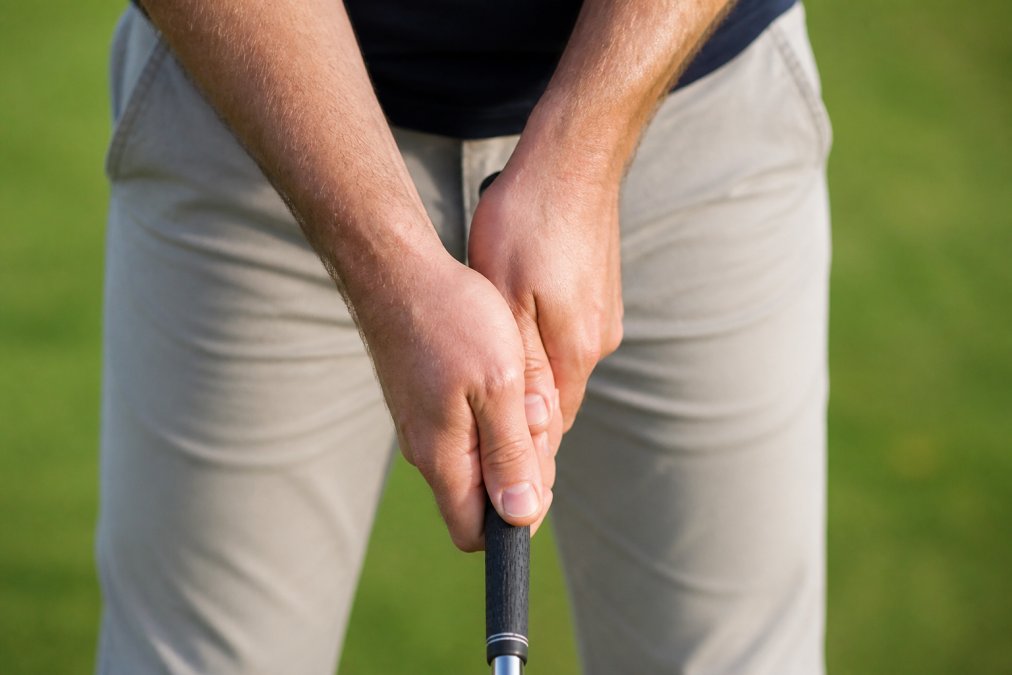
A weak grip opens the club face; a strong grip closes it. Most slicers benefit from moving toward strong, but avoid overdoing it, which creates hooks.
A stronger grip alone often reduces slice spin.
Check Your Alignment and Setup Position
Poor alignment forces an outside-in path. Stand behind the ball and align your feet, hips, and shoulders parallel to the target line, not at the target itself. Many golfers aim their body right, forcing an outside-in swing.
Check these alignment points:
- Feet parallel to target line
- Hips square to target line
- Shoulders square to target line
- Ball position in the middle of your stance
- Spine angle tilted slightly away from target
Position the ball in the center of your stance for irons, slightly forward for drivers. Start with 50/50 weight split, shifting slightly right during the takeaway. Many golfers fix their slice by correcting alignment alone. Maintaining this balanced posture throughout the swing remains essential even when you need to golf with joint pain to ensure your mechanics do not compensate in ways that exacerbate a slice.
Fix Your Takeaway and Swing Path
The takeaway sets your entire swing path. Mobility limitations often prevent proper execution.
The mobility connection to takeaway problems
Poor thoracic spine rotation or limited hip flexibility restrict the takeaway. Tight thoracic spine causes excessive shoulder rotation, lifting the club outside the target line. Limited hip internal rotation prevents proper coil, forcing the upper body to dominate and pull the club outside.
Perform these mobility checks: (1) Thoracic rotation, rotate your torso 45+ degrees each direction with arms crossed. (2) Hip internal rotation, sit with one leg extended, rotate the other knee inward; it should move toward the midline. (3) Shoulder mobility, reach across your body and pull your elbow toward your opposite shoulder.
Address mobility restrictions before drilling takeaway patterns.
Proper takeaway mechanics
Assuming adequate mobility, the takeaway should follow this sequence:
Move the club straight back for the first 30 cm, keeping hands within 15 cm of your torso. Keep wrists flat, rotate shoulders while hips stay still. This inside path prevents an over-the-top position.
Common takeaway mistakes: moving the club outside the target line too early, lifting too steeply, over-rotating shoulders, breaking wrists too soon, or allowing the right elbow to drift away from the body.
The transition: where most slices originate
Most slices originate in the transition. Initiate the downswing with your lower body, shift weight left, then clear your hips. Feel your left hip move toward the target before your shoulders rotate. This prevents the upper body from dominating.
Maintain forward shaft lean at address and impact (hands 10-15 cm ahead of the ball) to square the club face and reduce the open face that causes slices.
Practice this progression: takeaway low and inside, transition with lower body first, maintain shaft lean through impact. Start with half-swings, progress to three-quarter swings, then full swings. If you still struggle with an outside-in path after confirming adequate mobility, focus on the lower-body-first transition cue.
Cobra Golf OPTM MAX-D Driver 2026 →
Best Driver Settings for Slice Correction
Driver settings can reduce slice spin, but the right adjustment depends on diagnosing which aspect of your ball flight causes the slice. Choosing the wrong adjustment wastes money and frustration.
Your slice is caused by club face angle, swing path, or spin axis. Heel-weighted drivers close the club face faster. Weight adjustments and lie angle changes encourage an inside-out path but cannot override fundamentally outside-in swings. Loft and launch angle adjustments change spin axis only if swing mechanics are sound.
Loft adjustment and launch angle
Higher loft (12-14 degrees) increases launch angle and reduces side spin but reduces distance. Lower loft requires more swing speed and can exacerbate a slice below 85 mph. Most slicers benefit from higher lofts.
Weight position and draw bias
Moving weight toward the heel promotes draw bias and squares the club face faster, but reduces forgiveness on off-centre hits. Moving weight toward the toe increases fade bias, worsening a slice. A CG moved forward and low reduces spin; moved back and high increases spin.
Lie angle adjustment
Upright lie angle closes the club face at impact; flat lie angle opens it. Adjusting to upright can reduce slice spin, but only if swing mechanics are sound.
Moment of inertia (MOI) and forgiveness
Higher MOI drivers maintain more consistent ball flight on off-centre hits, reducing slice severity on mishits, though not eliminating slices caused by swing mechanics.
How to choose the right adjustment
A launch monitor (Trackman 4 or similar) measures club head speed, ball speed, launch angle, spin rate, spin axis, and smash factor. Using this data, a fitter determines whether your slice is caused by launch angle, spin rate, or club face angle, then adjusts accordingly. If your swing path is severely outside-in, driver settings alone won't fix the slice.
Common driver features for slice correction
Consider these driver features when addressing a slice:
- Draw-bias design: Heel-weighted CG promotes a draw and squares the club face faster. Brands like Cobra OPTM MAX-D are specifically designed for this.
- Adjustable hosel: Allows you to change loft (typically ±1-2 degrees) and lie angle (typically ±2 degrees) without replacing the club.
- Lower and forward centre of gravity: Reduces spin and promotes a higher launch angle, helping the ball carry further with less curve.
- Optimised moment of inertia (MOI): Higher MOI reduces the effect of off-centre hits, maintaining more consistent ball flight.
- Shaft flex options: A softer shaft (regular or senior flex) can help golfers with slower swing speeds launch the ball higher and reduce spin.
The equipment-swing mechanics balance

Equipment can help reduce a slice, but it cannot override poor swing mechanics. A draw-bias driver will help square the club face, but if your swing path is severely outside-in, you'll still slice. The most effective approach combines proper swing mechanics with equipment suited to your swing characteristics.
If you've worked on grip, alignment, and swing path drills without seeing improvement, a professional fitting with launch monitor data is the next step.
Drills to Stop Slicing the Driver
Drills build the muscle memory needed to fix golf slice issues consistently. Practice these drills 2-3 times per week at the range.
Self-Diagnosis Through Video Analysis
- Does the club come from outside the target line in the downswing?
- Is your club face open at address or during the takeaway?
- Does your upper body start the downswing before your lower body?
- Is your alignment square, or do your shoulders aim right?
Major Golf Direct's custom fitting process includes video analysis. Our PGA Professionals film your swing, review it frame-by-frame, and show you exactly what's happening. Combined with Trackman 4 data, this analysis pinpoints the root cause and the best fix.
| Slice Fix | Primary Cause | Time to See Results |
|---|---|---|
| Stronger grip | Open club face | 1 practice session |
| Alignment check | Outside-in path | 1 practice session |
| Takeaway drill | Over-the-top position | 1-2 weeks |
| Driver settings | Launch angle or spin | 1 fitting session |
| Swing path drill | Outside-in club path | 2-3 weeks |
Frequently Asked Questions
What is the most common cause of a golf slice?
The slice most commonly results from an outside-in swing path combined with an open clubface at impact. This happens when your club approaches the ball from outside the target line while the face points right of your swing path (for right-handed golfers). A weak grip, poor alignment, and an over-the-top downswing transition are frequent culprits. Addressing your grip strength and swing plane will fix the slice consistently.
Can a weak grip cause a slice?
Yes. A weak grip, where your hands rotate too far to the left on the club, makes it difficult to square the clubface through impact. Your hands cannot rotate the club fast enough to close the face, resulting in side spin that curves the ball right. Strengthening your grip by rotating both hands slightly clockwise positions you to release the club and square the face naturally, eliminating the slice.
Is there a driver that fixes a slice?
Equipment can help. The Cobra Golf OPTM MAX-D Driver is specifically designed for slice correction, featuring left-bias weight placement that squares the clubface quicker and promotes a straighter ball flight. Its heel-biased centre of gravity reduces gear effect and delivers up to 23% tighter dispersion on off-centre hits. However, equipment alone won't fix a slice, you must also improve your swing mechanics and grip.
How does club face angle affect ball flight?
The clubface angle at impact is the primary determinant of initial ball direction. An open face (pointing right of your swing path) causes a slice; a square face sends the ball straight; a closed face produces a draw or hook. Your swing path determines the spin axis, but the face angle controls where the ball starts. Combining a neutral grip with proper swing path ensures the clubface is square at impact, eliminating the slice.