Table of Contents
- What Golf Club Repair and Adjustment Services Cover
- Golf Club Regripping: Restoring Grip and Control
- Golf Club Shaft Replacement: Improving Performance and Feel
- Golf Club Loft and Lie Adjustment: Fine-Tuning Your Setup
- Golf Club Repair Cost and What to Expect
- Repair, Replace, or Adjust: Making the Right Decision
- Frequently Asked Questions
Last Updated: October 7, 2026
What Golf Club Repair and Adjustment Services Cover
Golf club repair and adjustment services encompass a range of professional interventions designed to restore performance, extend equipment lifespan, and fine-tune your setup to match your swing. At Major Golf Direct, we understand that clubs are precision instruments, and when they're not performing as they should, the problem often lies not with your swing but with the equipment itself.
These services fall into several distinct categories: grip replacement, shaft work, loft and lie adjustments, and structural repairs. Each addresses a different aspect of club performance and longevity. A worn grip compromises control and consistency. A damaged shaft affects trajectory and feel. Incorrect loft and lie angles can cost you distance and accuracy.
The typical golfer encounters these issues gradually. Grips deteriorate from use and exposure. Shafts can crack or bend from impact or age. Club heads can shift or loosen. Rather than replacing entire clubs, targeted repair and adjustment services often restore them to near-original performance at a fraction of the replacement cost.
Golf Club Regripping: Restoring Grip and Control
Regripping is the most straightforward and frequently needed club repair service. Your grips are the only point of contact between your hands and the club, and they wear faster than any other component.
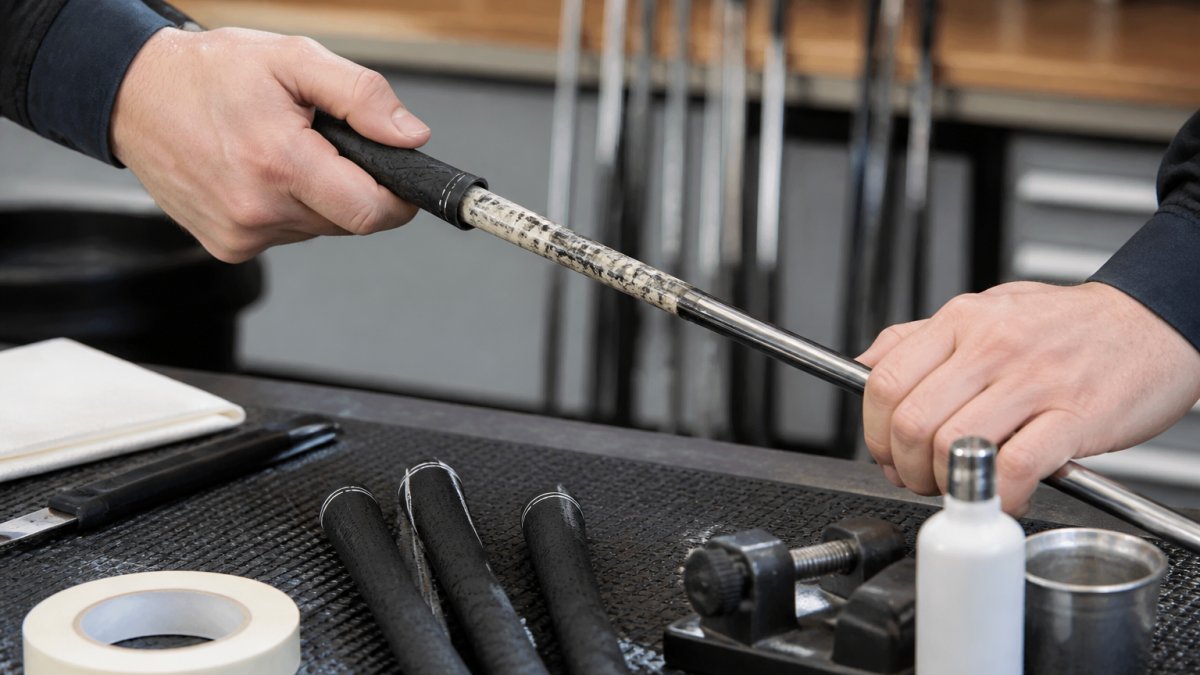
Close-up of a technician's hands removing an old golf grip from a club shaft, showing grip tape and adhesive residue, with fresh grips and specialized tools arranged on the workbench
A fresh grip restores traction, reduces hand fatigue, and improves shot consistency. Over time, grips become slick, compressed, and lose their texture. You'll notice it first in humid conditions or after a round in the rain, your hands slip, you compensate with grip pressure, and your swing mechanics suffer.
The regripping process involves removing the old grip, cleaning the shaft, applying new grip tape and adhesive, and installing the replacement grip. It's straightforward work, but it requires proper tools and technique to avoid damaging the shaft.
When to Replace Your Grips
Grips typically last 40 to 60 rounds of golf, depending on climate, frequency of play, and grip quality. Signs that replacement is overdue include visible wear, a slick or shiny surface, hardened rubber that no longer compresses, or noticeable loss of traction even when dry.
Many golfers wait too long to regrip. By the time you're consciously fighting for control, your swing mechanics have already adapted to compensate, and those bad habits persist even after new grips are installed. A proactive approach is to regrip every 18 to 24 months, regardless of how the grips feel.
Grip Options and Pricing
Grip selection matters more than many golfers realise. Different grips offer different textures, weights, and feel profiles. A softer grip absorbs vibration but may feel less responsive. A firmer grip provides more feedback but requires more hand strength.
Major Golf Direct stocks grips across the performance spectrum. The Golf Pride Tour Velvet 360 Standard Mens Golf Grip at £7.49 delivers the classic Tour Velvet feel with a non-slip surface pattern and consistent traction. For golfers with larger hands, the Golf Pride Tour Velvet 360 Midsize Golf Grips at £9.99 provide the same proven performance in a larger diameter.


For all-weather performance in variable conditions, the Golf Pride Multi Compound Classic Align Max - Standard at £18.95 combines rubber and cord with patented Align Max technology for consistent hand placement. The raised ridge locks in your hand position, reducing shot-to-shot variation.

Golf Pride Multi Compound Classic Align Max - Standard
For ladies golfers, the Masters Golf TourDri Undersize Ladies Golf Grip at £3.95 provides a smaller diameter with densely-spaced surface pattern for reliable lateral traction.
Golf Club Shaft Replacement: Improving Performance and Feel
Shaft replacement, or reshafting, is a more involved service than regripping but often delivers dramatic improvements in performance. Your shaft influences launch angle, spin rate, trajectory, and feel more than any other component except the club head itself.
Reshafting makes sense when a shaft is damaged, cracked, bent, or loose at the hosel, or when you want to change the performance profile of an existing club head. A stiffer shaft reduces spin and launch for golfers with fast swing speeds. A more flexible shaft increases both for golfers with moderate tempos. A lighter shaft can increase club head speed; a heavier one can improve control.
When Reshafting Makes Sense
Reshafting is justified when the club head itself is sound but the shaft no longer matches your swing. This is common when golfers improve their swing speed or tempo, or when they've been fitted with equipment that wasn't optimised for their actual swing characteristics.
A bent or cracked shaft requires replacement, continuing to use it risks further damage and inconsistent performance. A loose shaft at the hosel (where the shaft meets the club head) can sometimes be repaired through re-epoxying, but if the damage is extensive, replacement is the more reliable option.
Shaft Selection and Specifications
Shaft selection depends on swing speed, tempo, and desired ball flight. Slower swing speeds benefit from more flexible shafts that generate higher launch and spin. Faster swing speeds require stiffer shafts to control trajectory and reduce excessive spin.
The Wishon S2S White Driver Shaft at £39.99 is engineered for golfers with average swing characteristics, smooth to average tempo and average strength. The slightly stiffer lower tip section provides more control through impact for tighter dispersion.
For golfers seeking premium performance with Tour-level specifications, the KBS Tour Driven Driver Shaft at £59.99 delivers next-generation design optimised for spin and launch. The Butt to Tip Energy Transfer model enhances club head speed and stability while maintaining the feel KBS is known for.
The Adila NV Green Driver Shaft at £69.99 combines proven technology with modern construction. High-strength carbon fibre and NexGen Micro Laminate Technology eliminate unwanted gaps during manufacturing, enhancing feel and reducing shot-to-shot variability. This shaft delivers stable, low-launch performance that has proven reliable for two decades.
Golf Pride Tour Velvet 360 Midsize Golf Grips →
Golf Club Loft and Lie Adjustment: Fine-Tuning Your Setup
Loft and lie adjustments are precision work that directly affects how the club performs at impact. Loft is the angle of the club face relative to vertical; lie is the angle of the shaft relative to the ground when the club is soled.
Incorrect loft and lie angles cause systematic misses. A club with lie angle too upright tends to push shots right (for right-handed golfers); too flat tends to pull them left. Loft affects launch angle and spin rate, too much loft produces excessive height and spin; too little produces a lower, harder-running shot.
How Adjustments Affect Ball Flight
Increasing loft adds launch and spin; decreasing loft reduces both. Adjusting lie angle corrects directional bias caused by club head angle at impact. These adjustments are not cosmetic, they directly change where the ball goes and how far it travels.
Many golfers assume their clubs are correctly spec'd from the factory. In reality, manufacturing tolerances and individual swing characteristics mean that off-the-shelf clubs often don't match your actual swing. A professional loft and lie check using laser measurement tools identifies these discrepancies and corrects them.
A typical adjustment involves heating the hosel, carefully bending the shaft to the desired lie angle, and verifying the new angle with precision equipment. Loft adjustments on modern adjustable club heads are simpler, a wrench and the correct adjustment sequence change the loft without affecting the club's structural integrity.
The benefit is immediate and measurable. Golfers typically see tighter shot dispersion, improved directional consistency, and often a small distance gain from optimised launch conditions.
Adjustment |
Effect on Ball Flight |
When to Consider |
|---|---|---|
Increase loft |
Higher launch, more spin |
Slower swing speed, seeking more distance |
Decrease loft |
Lower launch, less spin |
Faster swing speed, seeking control |
Upright lie |
Reduces rightward miss |
Taller golfer, upright swing plane |
Flat lie |
Reduces leftward miss |
Shorter golfer, flatter swing plane |
Golf Club Repair Cost and What to Expect
Repair costs vary significantly based on the service. Regripping is the most affordable, typically £8 to £20 per club depending on grip selection and labour. A full set of 14 clubs regripped ranges from £112 to £280.
Reshafting costs more because it requires removing the old shaft, preparing the hosel, installing the new shaft, and re-gripping. Labour typically runs £30 to £50 per club, plus the shaft cost. A driver reshaft with a mid-range shaft like the Wishon S2S White at £39.99 totals roughly £70 to £90 all-in. A premium shaft like the Adila NV Green at £69.99 brings the total to £100 to £120.
Loft and lie adjustments typically cost £15 to £40 per club, depending on whether you're adjusting lie angle only (simpler, less expensive) or both loft and lie (more involved). A full set adjustment might run £60 to £160.
Repair Timelines and Service Quality
Quality matters significantly. Poor regripping work can result in grips that slip or feel unstable. Improper reshafting can leave excess epoxy in the hosel, affecting performance. Incorrect loft and lie adjustments waste the entire investment.
Look for technicians who use proper equipment, laser loft and lie measurement tools, appropriate epoxy and solvents, and grip installation machines that ensure consistent grip installation.
Repair, Replace, or Adjust: Making the Right Decision
The decision to repair, replace, or adjust depends on the club's condition, age, and your budget.
Repair makes sense when the club head is sound and the issue is a worn grip, damaged shaft, or suboptimal setup. A club with a cracked grip or bent shaft can often be restored to full performance at a fraction of replacement cost.
Replace when the club head itself is damaged, a large dent, structural crack, or worn face, or when the club is so old that multiple systems need attention simultaneously.
Adjust when the club is relatively new but not performing as expected. A loft and lie check costs little and often reveals that the issue isn't your swing, it's the club setup. Many golfers spend money on lessons when a simple adjustment would solve the problem.
Golf club repair and adjustment services are investments in consistency and longevity. Rather than replacing clubs prematurely, targeted repairs restore performance and extend the life of quality equipment.
Frequently Asked Questions
How much does golf club repair cost?
Repair costs vary depending on the service. Regripping typically starts from £3.95 for a basic grip like the Masters Golf TourDri, up to £18.95 for premium options like the Golf Pride Multi Compound Align Max. Shaft replacement ranges from £39.99 for the Wishon S2S White to £69.99 for the Aldila NV Green. Loft and lie adjustments and other repairs depend on complexity, so professional assessment is recommended for accurate pricing.
When should I replace a golf club grip?
Replace your grips when they become worn, slippery, or damaged. Signs include visible cracks, loss of texture, or difficulty maintaining control in wet conditions. Most golfers replace grips every 1-2 years depending on usage. Quality replacement grips like Golf Pride Tour Velvet (£7.49-£9.99) offer excellent non-slip performance and restore confidence in your swing.
What's involved in golf club shaft replacement?
Shaft replacement, or reshafting, involves removing the old shaft and installing a new one matched to your swing characteristics. This affects launch angle, spin rate, and feel. Options range from the Wishon S2S White (£39.99) for average swing speeds to the KBS Tour Driven (£59.99) for optimised performance. Professional fitting ensures the shaft matches your tempo and swing speed.
Can the loft and lie of a golf club be adjusted?
Yes, loft and lie adjustments are common repairs that fine-tune club performance. Adjusting loft affects launch angle and distance; adjusting lie affects whether the club sits square at address and influences shot direction. These adjustments require specialist equipment and should be performed by professionals to ensure accuracy and maintain club integrity.