Table of Contents
- What Forged and Cast Irons Actually Are
- How Forging and Casting Differ
- Feel, Feedback, and Impact Response
- Forgiveness and Off-Centre Strike Performance
- Cast Irons Forgiveness: Design Over Manufacturing
- Workability, Shot Shaping, and Consistency
- Forged Irons for High Handicappers: Myth and Reality
- Forged Iron Loft and Lie Adjustment Flexibility
- Frequently Asked Questions
Last Updated: October 20, 2026
What Forged and Cast Irons Actually Are
Forged irons are clubheads created by heating steel to extreme temperatures and hammering it into shape. Cast irons are made by pouring molten metal into moulds and letting it cool. Understanding forged vs cast irons reveals that the methods produce different characteristics, though marketing often overstates the gap.

Manufacturing method does not automatically determine performance. A forged iron is not inherently more forgiving than a cast iron, and a cast iron is not automatically less responsive. Titleist research notes muscle-back forged irons tend to have smaller effective sweet spots and less moment of inertia than modern cavity-backs, while GolfTEC research shows cast-iron advances have made cast clubs remarkably versatile.
What matters is clubhead design, materials, and how well the club matches your swing. Understanding the process helps you decode marketing claims, but should not drive your decision alone.
How Forging and Casting Differ
The Forging Process
Forging begins with steel billets heated to around 1,100°C, where the metal becomes malleable. A hammer or press then shapes the steel into the iron head, compressing and aligning the grain to create a denser material at the point of impact.
Timing is critical: remove the steel too early and it becomes brittle; wait too long and it cools unevenly, creating weak points. Master forges like Endo in Japan have perfected this timing over decades, which is why precision-forged irons command premium prices.
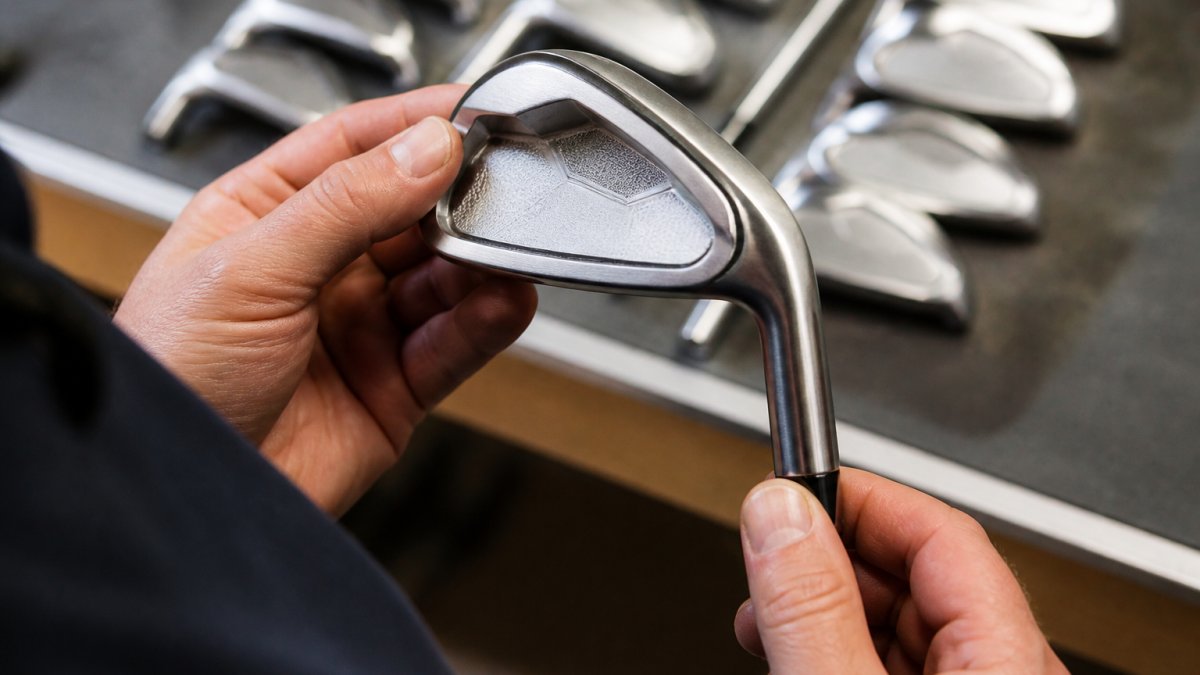
Once forged, the clubhead is machined to its final shape and face grooves. The compressed grain structure remains, and this is where the "soft feel" reputation comes from: dense grain absorbs and releases energy differently than cast material.
Forged irons typically cost more to produce. The process demands skilled labour, precise equipment, and careful quality control. A single mistake in timing or temperature ruins the batch.
The Casting Process
Casting works differently: engineers create a mould, pour in molten steel or stainless steel, and let it cool and solidify into the mould's shape. The casting is then removed and finished through machining and polishing.
Casting offers design flexibility forging cannot match. Cavity backs, perimeter weighting, and hollow-body construction became possible because casting lets engineers place material exactly where they want it; complex internal structures are hard to create through forging.
Casting also scales efficiently: once the mould exists, you can produce hundreds of clubheads with consistent results, which is why cast irons maintain tight tolerances within a set.
Cast irons do not carry the same "soft feel" reputation as forged irons, but this is changing. Modern urethane cavity fills and face technology have narrowed the gap significantly. The Wilson Golf Dynapwr Forged Steel Irons, for example, use a TE-031 urethane-filled cavity that absorbs vibrations and delivers a smooth, solid response at impact.

Feel, Feedback, and Impact Response
Feel is where the distinction matters most to experienced golfers. Forged irons deliver direct, unfiltered feedback at impact, you feel the exact point where the club strikes the ball, and that feedback loop helps skilled players make micro-adjustments.
Cast irons, especially those with cavity fills and multi-material construction, dampen vibrations more aggressively for a softer, more muted response. Many golfers prefer this feel, which seems more forgiving and less "harsh" on mishits.
The real difference is what you want from impact feedback: low-handicap golfers often prefer the direct response of forged irons to refine technique, while higher-handicap golfers often find the softer cast response more encouraging on off-centre strikes.
Neither approach is objectively better. The Mizuno Golf Pro M-13 Forged Irons deliver unparalleled feel and feedback in the scoring irons through pure one-piece grain-flow forged construction. The Srixon Golf ZXi7 Gen 2 Forged Irons use a PureFrame iQ design that creates an irresistibly soft, remarkably stable feel through a wider, thicker ridge of softer steel forged directly behind the sweet spot. Both are forged and both deliver excellent feedback; the difference is how each manufacturer interprets what feedback should feel like.

Forgiveness and Off-Centre Strike Performance
Forgiveness is where the forged-versus-cast debate is most often misframed. Calling forged irons unforgiving and cast irons forgiving conflates two variables: how the head was made and how it was designed.
The mechanism is straightforward: strike the ball away from the sweet spot and the clubhead wants to twist. Higher MOI resists that twisting, so less energy is lost and the ball retains more speed and starts closer to the intended line.
That is why a like-for-like comparison matters more than a manufacturing label. Comparing a forged blade against a cast game-improvement iron measures blade-versus-cavity design, not forging-versus-casting.
A transparent way to judge forgiveness is to measure mishit retention. On a launch monitor, compare centre strikes against strikes 10-15 mm toward the toe and heel, recording ball speed, carry distance, and lateral dispersion. A forgiving head keeps ball speed within a narrow band and dispersion tight; a demanding head shows a steep drop-off.
Modern multi-material construction has blurred the line further. Hollow-body irons with a forged face welded to a cast body, and forged heads with internal tungsten and urethane, are neither purely forged nor purely cast.
Cast Irons Forgiveness: Design Over Manufacturing
Cast irons have built a reputation for forgiveness, and there is truth to it, but the forgiveness comes from design choices enabled by casting, not casting itself.
Because casting allows complex internal structures, manufacturers can place tungsten weights in the perimeter, raising moment of inertia and spreading the sweet spot. Cavity backs, hollow-body designs, and multi-material construction all become possible with casting.
Wilson Golf Dynapwr Forged Steel Irons 2026 →
However, these features are not exclusive to casting. The Mizuno Golf Pro M-15 Forged Irons use forged construction in the long irons but incorporate hollow-body design with tungsten weighting in the 4 to 7-irons, design techniques traditionally associated with cast irons. The result is higher launch and extra forgiveness throughout the set while retaining refined shaping and forged heritage.
The critical insight: manufacturing method and clubhead design are separate variables, and conflating them leads to poor decisions. A forged iron can be forgiving; a cast iron can demand precision. What matters is how the manufacturer engineered the specific clubhead you are considering.
Feature |
Forged Irons |
Cast Irons |
|---|---|---|
Manufacturing |
Steel heated and hammered into shape |
Molten metal poured into moulds |
Grain structure |
Compressed and aligned |
Uniform and consistent |
Design flexibility |
Limited by forging process |
High, complex internal structures possible |
Typical feel |
Direct, unfiltered feedback |
Softer, more damped response |
Perimeter weighting |
Harder to achieve |
Easier to incorporate |
Production cost |
Higher per unit |
Lower per unit at scale |
Consistency club-to-club |
Tighter tolerances possible |
Highly consistent |
Workability, Shot Shaping, and Consistency
Workability, deliberately curving the ball or controlling trajectory, is often attributed to forging, but the mechanism is more specific. Shot shaping depends on how much the face can be rotated at impact and how much the head's CG resists that rotation.
Workability therefore tracks head geometry, not manufacturing method.
Consistency is a separate question and is often misdescribed. Casting from a reusable mould produces tight head-to-head tolerances within a set, a genuine strength.
A controlled comparison is the only way to separate these effects. On a launch monitor, hit stock shots and deliberate draws and fades with each candidate head, keeping shaft, loft, and ball constant, and record carry distance, lateral dispersion, and shot shape.
For most golfers, the workability gap between a modern forged player's iron and a modern cast player's iron is negligible. Loft and lie fitting, shaft profile, and how the head's CG matches your angle of attack matter more.
Forged Irons for High Handicappers: Myth and Reality
Conventional wisdom says high-handicap golfers should avoid forged irons because they lack forgiveness. That advice is outdated and often wrong.
High-handicap golfers benefit from forgiveness, but also from the feedback forged irons provide. If a club tells you that you struck it off-centre, you can learn and adjust; if it masks every mishit with a soft feel, you never develop the awareness needed to improve.
The real decision for a high-handicap golfer is not forged versus cast but cavity back versus blade, and perimeter weighting versus centre-weighted design. A forged cavity-back iron with tungsten weighting can be ideal because it combines feedback with forgiveness.
The Wilson Golf Dynapwr Forged Steel Irons illustrate this: they are forged but feature cavity back design, variable face technology, and low centre of gravity. High-handicap golfers using them report greater confidence and more consistent distances, not despite the forged construction, but because the overall design suits their needs.
The mistake is assuming forged equals unforgiving and cast equals forgiving. Evaluate the specific clubhead design, not the manufacturing method.
Forged Iron Loft and Lie Adjustment Flexibility
One genuine advantage of forged irons is that they can be adjusted more safely. Forged steel is more ductile and can be bent without cracking, while cast metal, particularly stainless steel, is more brittle and risks cracking under adjustment pressure.
This matters if you need significant loft and lie adjustments after purchase. A skilled club fitter can adjust a forged iron several degrees without compromising the clubhead's integrity. The same adjustment on a cast iron carries more risk.
However, this advantage only matters if you actually need adjustments.
For golfers who buy off-the-shelf and then need adjustments, forged irons offer more flexibility. For golfers who invest in custom fitting upfront, this advantage becomes irrelevant.
The practical takeaway: buying without fitting? Forged irons offer more adjustment safety. Getting fitted properly? Buy based on performance and feel, not adjustment potential.
Choosing between forged and cast irons means looking past marketing claims and focusing on what your swing actually needs. The best way to determine this is through custom fitting with advanced technology.
Frequently Asked Questions
Should I get forged or cast irons?
The choice depends on your skill level, budget, and what matters most to you. Forged irons excel at feel, feedback, and workability—ideal for mid-handicap and low-handicap golfers who value shot control. Cast irons offer superior forgiveness, higher launch, and often cost less, making them better for high-handicappers and beginners. Modern manufacturing has blurred the line: many forged irons now include cavity-back designs for forgiveness, while some cast irons deliver impressive feel. A custom fitting with Trackman 4 technology can reveal which construction suits your swing DNA and performance goals.
Are forged irons more forgiving than cast irons?
Not necessarily. Forgiveness depends primarily on clubhead design—cavity-back shape, perimeter weighting, and moment of inertia—not manufacturing method alone. Cast irons typically offer more forgiveness because their design flexibility allows engineers to position weight strategically around the clubhead. However, modern forged irons like the Wilson Golf Dynapwr (£799.00) combine forged construction with cavity-back design and advanced weighting to deliver excellent forgiveness alongside feel. The real difference: cast irons are engineered for maximum off-centre hit stability, while forged irons prioritise feedback and shot control for skilled players.
Can you bend forged irons more easily than cast irons for loft and lie adjustment?
Yes. Forged irons are generally easier to adjust because the material responds more predictably to bending. The grain structure of forged steel allows clubmakers to alter loft and lie angles with less risk of damage or inconsistency across the set. Cast irons, being harder and more brittle, are more prone to cracking or permanent deformation during adjustment. If you anticipate needing loft and lie adjustments—whether for fitting refinement or swing changes over time—forged irons offer greater flexibility and durability through multiple adjustments.
Do forged irons feel softer than cast irons?
Typically yes, but modern construction has narrowed the gap. Forged irons, especially those made from carbon steel or premium alloys, transmit a softer, more responsive feel at impact because the grain structure absorbs and releases energy differently. Cast irons, being denser, can feel harder and more muted. However, advanced casting techniques and urethane-filled cavities—like the TE-031 cavity in the Wilson Golf Dynapwr—can replicate softer feel in cast designs. Feel is subjective and varies by individual sensitivity; a professional fitting is the best way to experience the difference firsthand.