Table of Contents
- Does Custom Club Fitting Actually Improve Scores?
- Is Golf Club Fitting Worth It?
- What Happens During the Golf Club Fitting Process
- How Long Does a Golf Club Fitting Take?
- Trackman Golf Club Fitting: What the Data Reveals
- Who Benefits Most from Custom Fitting
- Separating Equipment Gains from Other Factors
- Frequently Asked Questions
Last Updated: October 18, 2026
Does Custom Club Fitting Actually Improve Scores?
The straightforward answer: custom club fitting improve scores, but it's not a magic fix. At Major Golf Direct, we've fitted thousands of golfers with Trackman 4 technology, and equipment matters less than most people think, but more than they're willing to admit.

Here's what the research actually shows. According to Golf Datatech's custom fitting analysis, custom-fit clubs may lessen some negative outcomes associated with a poor swing or strike.
The real question is whether the improvement justifies the investment, and whether you're the type of golfer who'll benefit. Below: how fitting works, who sees real gains, and how to measure whether it's worth it.
Is Golf Club Fitting Worth It?
Custom club fitting improve scores when the equipment change removes a repeatable problem you can see in your data, and if you play enough for that fix to compound. The value is in playing clubs matched to your actual swing, then measuring whether the change holds up on the course.
An off-the-rack club is built around a broad average; your swing is not. When equipment doesn't match your mechanics, you compensate on every swing, and that costs you consistency.
What fitting actually changes
A fitting session is a diagnostic. It identifies which of these problems your current clubs are causing:
- Directional bias from lie angle that does not match your posture at impact
- Inconsistent distance gaps from loft and shaft weight mismatches
- Wasted speed from a shaft flex or profile that does not load the way you swing
If your data shows none of these, fitting has little to fix. If it shows two or three, the case strengthens quickly.
KBS Tour Driven Driver Shaft
Session types and what they cost
Fitting is not one product. The price depends on what you are buying:
- Fitting-only session (no purchase): typically £30-£150 for a single club or a short bag session. You leave with a specification sheet you can take elsewhere.
- Full-bag fitting with purchase: often £100-£200, frequently credited against the club order if you buy through the fitter.
- Purchase-inclusive packages: the fitting fee is absorbed into the club price, so the effective cost of the session is zero, but you are tied to that fitter's stock and pricing.
Ask two questions before booking: is the fitting fee credited against a purchase, and what is the re-spec policy if the clubs don't perform on the course?
A simple break-even way to think about it
Do not justify fitting on strokes alone. Justify it on the problem it removes. A 15-yard gap between two irons you use on every approach costs you shots across a season; a lie-angle correction that stops a consistent left miss means you're no longer steering around your own equipment.
A rough test: count your rounds in a year. If it's a handful, the per-round cost of a full fitting and new set is high and the compounding minimal.
What fitting will not do
Fitting will not fix a swing that changes from week to week, and it will not replace lessons. If your mechanics are still moving, a specification matched to today's swing may not suit next season's. That is an argument for timing it once your swing has stabilised.
What Happens During the Golf Club Fitting Process
A proper fitting session combines two steps: understanding your swing, then testing equipment against it.
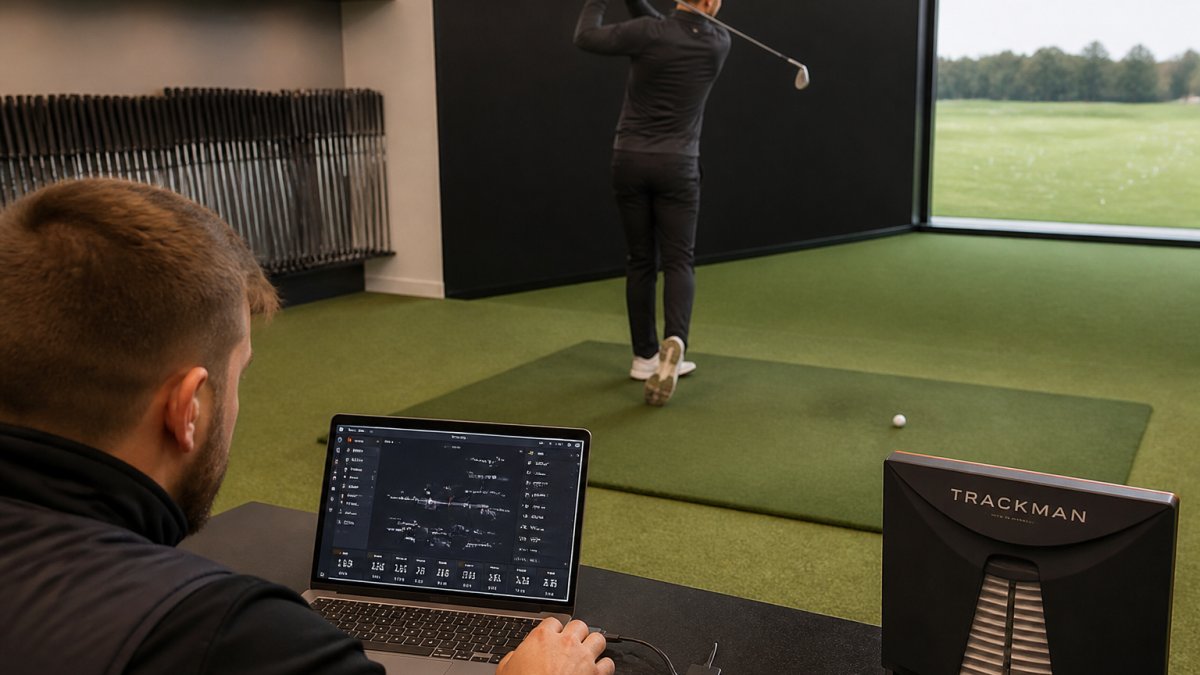
Baseline Assessment and Swing Analysis
The session starts with a baseline: your fitter watches you hit shots and records what's happening at impact. Trackman 4 launch monitors measure:

- Club speed at impact
- Ball speed off the clubface
- Launch angle and spin rate
- Carry distance and total distance
Your fitter identifies patterns, a consistent right miss, a launch angle too high or low for your swing speed, distance lost to poor strike quality. These measurements become your baseline, and everything tested after is compared against it.
Club Specification Testing and Optimisation
Once your fitter understands your swing, they test different club specifications. This is where the real work happens.
Club length affects posture and consistency: too long pulls you off balance, too short has you reaching.
Your fitter tests combinations of these specs against your baseline. The goal isn't the highest numbers, it's consistency and shot dispersion that matches your swing characteristics.
How Long Does a Golf Club Fitting Take?
A complete golf club fitting session typically takes 60 to 90 minutes, depending on how many clubs you're fitting and how thorough the fitter is. The breakdown:
- Initial assessment and baseline: 15-20 minutes
- Testing different specifications: 30-40 minutes
- Finalising selections and discussing options: 15-20 minutes
- Paperwork and ordering: 10 minutes
A driver or a few irons sits at the shorter end; a full bag takes longer because there are more variables to optimise. Don't rush it, a fitter who spends 30 minutes total is cutting corners. You want someone who tests thoroughly and explains the data.
Trackman Golf Club Fitting: What the Data Reveals
Trackman 4 is the industry standard because it captures the complete picture of impact and ball flight.
Here's what matters most: shot dispersion. This is how tightly your shots cluster around your target.
Custom fitting improves dispersion by matching club specs to your swing.
Trackman data shows these problems instantly.
The best part: you see the data yourself as different clubs are tested.
Who Benefits Most from Custom Fitting
Not every golfer gets the same return from fitting. The useful question is not 'is fitting good?' but 'is it likely to help me, given my handicap, swing consistency, current clubs and most common miss?' Here's how to judge.
By handicap and swing consistency
- Low handicappers with a repeatable swing: the biggest gains. When your strike and path are consistent, small specification changes show up clearly in dispersion and distance control. Fitting sharpens what is already there.
- Mid handicappers with a mostly repeatable swing: strong candidates, especially for driver and irons. The gains are less about peak numbers and more about tightening the spread between good and bad shots.
- Higher handicappers with an inconsistent swing: limited benefit from fine-tuning, but real benefit from basic corrections, length, lie angle, shaft weight, and grip size. Do not expect a full-bag optimisation to transform your scores; do expect fewer equipment-induced bad shots.
- Beginners still changing their swing: usually the weakest case. Your mechanics are moving, so a specification matched to today's swing may not fit next season's. Lessons first, fitting once the swing settles.
A simple consistency test: if your last ten drives or ten seven-irons cluster in a recognisable pattern, your swing is repeatable enough for fitting to matter. If they scatter with no pattern, equipment is not the main variable yet.
By the state of your current clubs
Fitting has the most to fix when your current equipment is clearly mismatched:
- Clubs bought off the rack with no length, lie, or shaft check
- A set assembled over years from different brands and specs
- Shafts clearly too stiff or too soft for your swing speed
- Grips that are worn, too thin, or too thick for your hand size
If your clubs were fitted recently and still suit your swing, a repeat session has less to add. If they were never checked, the diagnostic value alone is often worth the fee.
By your most common miss
Your miss tells you which specification is most likely to help:
- Consistent left or right miss with irons: lie angle is the first suspect. A lie that does not match your posture at impact tilts the face at the ground, and no amount of swing work fixes it cleanly.
- High, weak flight with the driver: loft and shaft profile are the likely levers. A lower-launching head or a stiffer-tipped shaft can bring flight and spin into a more playable window.
- Inconsistent strike across the face: length and swing weight are worth testing. A club that is too long pulls you out of posture; one that is too light or too heavy changes your tempo.
- Distance gaps between irons: loft gapping is the fix. Modern iron sets often have stronger lofts than the set they replaced, which compresses the gap at the top and stretches it at the bottom.
Who may see little improvement
Be honest about the cases where fitting is unlikely to move your scores much:
- Golfers whose swing changes significantly from round to round
- Golfers who play only a few times a year, where the per-round cost is high and the compounding is minimal
- Golfers whose main scoring losses come from course management, penalty shots, or short-game decisions rather than ball-striking
- Golfers who have been fitted recently and whose clubs still match their swing
None of these is a reason to avoid fitting forever, they are reasons to time it well and pair it with the work that actually moves scores: lessons, practice, and better decisions on the course.
Separating Equipment Gains from Other Factors
Here's the honest part most guides skip: custom fitting isn't the only thing affecting your scores.
This is why fitting alone doesn't guarantee lower scores. According to MyGolfSpy forum discussion on fitting effectiveness, fitting provides equipment suited to a golfer's swing, but does not guarantee better accuracy or lower scores.
Here's what realistic improvement looks like:
- Better equipment consistency: noticeable within a few rounds
- Tighter shot dispersion: measurable within a season
- Lower scores: depends on whether you also work on swing and course management
If you're serious about improving, combine fitting with lessons and regular practice. Track your own baseline: record your average score over 10 rounds before fitting, then again over 10 rounds after.
Custom club fitting works best when you're already committed to improving your game. If you've been frustrated with inconsistency or distance gaps, fitting often reveals problems your current clubs are causing.
At Major Golf Direct, our PGA Professional staff use Trackman 4 technology to build a complete picture of your swing. Our 0% Interest Free Finance option makes it accessible, and our Price Match Guarantee ensures you're getting fair value. Learn more about custom fitting and what to expect from the sport's governing body to understand how equipment standards work in competitive play.
Frequently Asked Questions
Can custom club fitting actually lower your handicap?
Custom club fitting improves the consistency and accuracy of your shots by matching clubs to your swing characteristics, launch angle, and ball flight. However, scoring depends on multiple factors: swing mechanics, course management, and practice quality all play significant roles. Fitted clubs reduce mishits and improve distance gapping, which helps on-course performance, but they cannot compensate for poor swing technique or lack of practice. The real benefit is maximising your current ability through equipment suited to your individual swing DNA.
What is the golf club fitting process?
The fitting process begins with a baseline assessment where a PGA Professional analyses your swing mechanics and impact characteristics using launch monitor data. You then test multiple club specifications—varying shaft flex, club length, lie angle, loft, and grip size—to identify which combinations produce the best ball flight, shot dispersion, and consistency for your swing. The fitting concludes with recommendations matched to your playability needs and budget. Advanced systems like Trackman 4 measure swing speed, launch angle, spin rate, and carry distance to ensure precision matching.
How long does a typical golf club fitting take?
A comprehensive fitting session usually takes 45 to 90 minutes, depending on the number of clubs being fitted and the depth of analysis required. Driver and irons fittings typically take longer than wedge or putter fittings.
Does Trackman 4 fitting guarantee better scores?
Trackman 4 provides precise data on swing speed, launch angle, spin rate, and ball flight, enabling highly accurate club matching. This technology helps identify the club specifications most suited to your swing, improving consistency and shot accuracy. However, the data itself does not guarantee lower scores—execution on the course, course management decisions, and your overall skill level determine your handicap. Trackman fitting optimises your equipment, but scoring improvement depends on applying that equipment consistently and practising effectively.