Last Updated: October 30, 2026
Quick Summary
For most beginners, the best golf putters are mallets with generous alignment aids and a higher moment of inertia, because their weight sits further from the centre and forgives off-centre strikes. Blades suit players who already have a repeatable stroke and want more direct feedback. Choose by head shape, length and grip, then test before buying.
- Mallets raise moment of inertia, so off-centre strikes hold their line better.
- Blades give more direct feedback but are less forgiving for developing strokes.
- Stand relaxed with eyes over or just inside the ball before choosing a length.
- Roll five putts with each candidate on the same green to compare starting lines.
- Models such as the Ray Cook Silver Ray SR400 start at £49.95 for budget buyers.
Table of Contents
- How We Chose These Beginner Putters
- Feature Comparison Table: Beginner Putters at a Glance
- Best Mallet Putters for Beginners
- Best Blade Putters for Beginners
- Face-Balanced vs Toe-Hang Putters: Which Suits a Beginner?
- Putter Length Guide: Getting Your Setup Right
- Choosing Your First Putter and Booking a Fitting at Major Golf Direct
- Frequently Asked Questions
Choosing one of the best golf putters for beginners is harder than it should be. Most beginners land on a shortlist of mallets and blades, then freeze, because the spec sheets read like engineering exams. The good news is that you only need to understand a handful of decisions to pick well. Major Golf Direct has put this guide together to cut through the noise and focus on what actually helps a newer golfer hole more putts.
The short answer: for most beginners, a mallet with generous alignment aids and a higher moment of inertia (MOI) will be the easiest to get on with. Blades suit players who already have a consistent stroke and want more feedback. The rest of this guide explains why, and shows you how to match one of the best golf putters for beginners to your own game.
How We Chose These Beginner Putters
We started with a range of beginner-suitable putters from our own catalogue.
We then filtered for what a beginner actually needs: forgiveness on off-centre strikes, clear alignment aids, a sensible price, and a shaft length and grip that are easy to set up. Every putter in this guide is sold through Major Golf Direct, so you can check current stock and pricing on each product page.
Feature Comparison Table: Beginner Putters at a Glance
The table below summarises the putters covered in this guide. Prices are the starting prices listed on our product pages.
Putter |
Head Style |
Starting Price |
Best For |
|---|---|---|---|
Ray Cook Silver Ray SR400 |
Blade-style |
£49.95 |
Budget-conscious first buyers |
Ray Cook Silver Ray SR500 |
Blade-style |
£49.95 |
Players wanting a slightly heavier head |
MacGregor ZT Plus Model 003 |
Multiple head shapes |
£69.95 |
Trying different looks |
Cobra MIM Camino SB |
Compact hollow mallet |
£219.00 |
Neutral-path stability |
Cobra MIM Stingray SB |
Rounded mallet |
£219.00 |
Clean look and forgiveness |
Cobra MIM Nova SB |
Fang-style mallet |
£219.00 |
Square look at address |
Odyssey Ai-Dual Square 2 Square Seven OS |
Zero-torque, centre-shafted |
£229.00 |
Consistent face delivery |
Odyssey Ai-Dual 1/2 Ball Square 2 Square Max OS |
Zero-torque, alignment aid |
£249.00 |
Improving aim |
TaylorMade Spider Tour #1 |
Mallet with high MOI |
£299.00 |
Feel and sound |
PXG One & Done ZT |
Zero-torque mallet |
£429.00 |
Premium stability |
Best Mallet Putters for Beginners
Mallets are often considered a forgiving choice for newer golfers, because their weight sits further from the centre of the head. That raises MOI, which generally helps off-centre strikes hold their line better.
The Cobra MIM range is a useful place to start. The Camino is a compact hollow mallet built for players with a neutral path. The Stingray is a rounded alternative with a clean, symmetrical look at address. The Nova is a fang-style head with a square profile, which many beginners find easier to aim. All three use Cobra's Descending Loft Technology, with four milled face lofts that help the ball launch consistently, and an adjustable weighting system so you can tune feel later.
If you are looking for a higher-MOI option with a softer feel, the TaylorMade Spider Tour #1 is worth a look. Its thin-wall undercut construction is built for high MOI, and its white TPU insert is designed for a softer feel. At £299.00 it sits well above the Cobra models, so it suits a player who has already decided the game is worth investing in.
Best Blade Putters for Beginners
Blades are the traditional shape: a slim, flat head with the weight spread more evenly along the face. They give more direct feedback, so you feel a poorly struck putt straight away. That feedback is useful once you have a repeatable stroke, but it can be unforgiving when you are still learning to strike the ball out of the centre.
For a beginner on a tighter budget, the Ray Cook Silver Ray range is a practical option. Both the SR400 and SR500 are priced at £49.95, which makes them among the most affordable models in our catalogue. Ray Cook's series is built around a slightly heavier head, which supports a smooth pendulum stroke and more consistent distance control. The mid-size paddle grip is comfortable for longer practice sessions.
If you want to try a few shapes before committing, the MacGregor ZT Plus range at £69.95 offers multiple head designs, from traditional blade to high-MOI mallet. That gives you a low-cost way to find out which shape your eye prefers before spending more.
Face-Balanced vs Toe-Hang Putters: Which Suits a Beginner?
This is the decision that confuses beginners most, because the terms describe the putter rather than the player. The practical question is simpler: does your stroke want the face to stay square, or does it want to rotate?
A face-balanced putter sits level when you balance it on your finger or a shaft, with the face pointing straight up. A toe-hang putter tips toward the ground at the toe. The amount of toe hang tells you how much the head wants to rotate during the stroke. A straight-back, straight-through stroke tends to suit a face-balanced putter; an arcing stroke tends to suit some toe hang.
How to find your stroke type without a fitting:
- Set up to a straight 3-metre putt on a practice green.
- Hit five putts and watch the putter head in your peripheral vision.
- If the head moves back and through on a straight line, you are a straight-back, straight-through player.
- If the head opens on the way back and closes through impact, you have an arc.
Most beginners have a slight arc, but many also have a stroke that is closer to straight than they think. If you are unsure, a face-balanced mallet is the safer starting point because it is more forgiving of a stroke that is still settling.
Zero-torque putters take this idea further. The Odyssey Ai-Dual Square 2 Square range uses a centre-shafted design that balances toe-up, and Odyssey describes this as promoting a square face throughout the stroke. The 2° of forward shaft lean built into these models presets your hands and reduces the chance of opening the face at address. PXG's One & Done ZT uses a similar principle: its onset hosel positions the shaft axis just above the centre of gravity, so the putter resists twisting through impact. Both are designed to reduce the face rotation that causes pushed and pulled putts.
PXG Golf Zero Torque One & Done Putter 2026 →
That does not make them automatically right for every beginner. A zero-torque putter will feel unusual if you are used to a traditional toe-hang model, and some players find the centre-shafted look distracting at address. Give yourself a few practice sessions before judging it.
A quick comparison for beginners:
- Face-balanced mallet: most forgiving for a stroke that is still developing, easy to aim, good for straight-back, straight-through players.
- Toe-hang blade or mallet: more feedback, suits an arcing stroke, but less forgiving on off-centre strikes.
- Zero-torque centre-shafted: designed to keep the face square, useful if you tend to twist the face open or closed, but takes adjustment.
The best way to decide is to test two putters side by side on the same green. Roll five putts with a face-balanced mallet and five with a toe-hang model from the same distance, and note which one starts the ball on your intended line more often. That is a more reliable guide than any spec sheet.
Putter Length Guide: Getting Your Setup Right
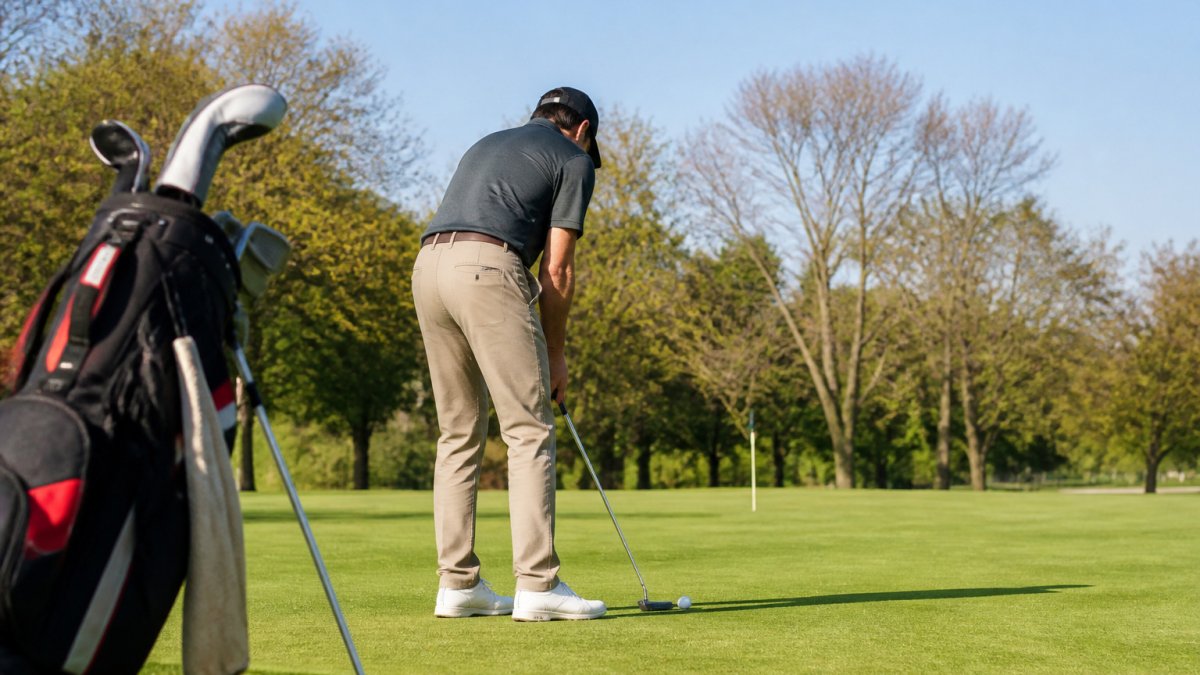
Length is the first fitting decision, and it is the one most beginners get wrong. A putter that is too long forces you to stand too upright and lifts your eyeline above the ball; one that is too short makes you hunch and pulls your shoulders out of line. Either way, your stroke has to compensate, and consistency suffers.
The putters in this guide are sold in a range of lengths, including options suitable for standard UK measurements on the models listed. As a starting point, take a relaxed posture with your eyes directly over or just inside the ball, let your arms hang naturally, and check where the grip sits. A useful starting check is that the top of the grip should sit roughly level with the crease of your lead wrist when you stand comfortably. If the grip finishes well above that crease, the putter is probably too long; if your hands sit below it and your forearms feel cramped, it is probably too short.
Length also changes how far you stand from the ball. A useful check is to set up without a putter, let your arms hang, and see where your hands fall. If you have to reach for the ball, you are standing too far away; if your hands are tucked under your chest, you are too close. Your eyes should be over the ball or slightly inside the target line, not outside it.
Lie angle matters too, though it is less talked about at beginner level. If the sole of the putter sits flat on the ground at address, the lie is roughly right. If the toe points up, the lie is too upright for you; if the heel sits up, it is too flat. The Cobra MIM range offers an adjustable weighting system. Ask about lie adjustment when you buy.
Grip size is the third piece. A grip that is too thin encourages hand action and face rotation; one that is too thick can deaden feel. Most beginners do well with a mid-size or oversize grip, which quietens the hands and makes it easier to keep the face square. If the standard grip on a putter feels slim, a replacement grip is an inexpensive way to test a larger profile before committing to a new putter.
Common setup mistakes to avoid:
- Standing too far from the ball, which pushes your eyes outside the line and makes alignment harder.
- Gripping the putter too tightly, which adds tension and twists the face.
- Ball position too far forward or back in the stance, which changes the effective loft at impact.
- Letting the shoulders open or close at address, which aims the putter offline before you even stroke it.
A simple fitting process you can do yourself:
- Set up in a relaxed posture with your eyes over or just inside the ball.
- Check that the sole sits flat and the grip top is near your lead wrist crease.
- Confirm your forearms are neither stretched nor cramped.
- Roll three putts from 3 metres and three from 6 metres, and note whether you tend to miss left or right.
- If you consistently miss one way, try a different length or lie before changing your stroke.
If you can, test two lengths side by side on a practice green. The difference between standard lengths is small on paper but obvious in posture, and posture is what makes a repeatable stroke possible.
Choosing Your First Putter and Booking a Fitting at Major Golf Direct
If you are unsure which model suits your stroke, the practical answer is to try a few options before you buy. Beginners who want to check their stroke or ball speed can use a portable launch monitor to measure it at home. Browse the full range of putters at Major Golf Direct to compare head shapes, lengths and prices side by side, then narrow your list to two or three models.
A simple checklist before you buy:
- Do I want more forgiveness (mallet) or more feedback (blade)?
- Have I checked the length against my posture at address?
- Does the shape suit my natural alignment and eye line?
- Is the price right for how often I will play?
- Can I test the putter, or do I need to buy with confidence on specs?
Putting is a skill that improves with practice, so the best first putter is the one you will use most. Once you have chosen a putter, you can also compare putter grips to find one that suits your hands. Start with a forgiving mallet or an affordable blade, practise consistently, and revisit your choice once your stroke has settled. For most newer golfers, that approach leads to more holed putts and more enjoyable rounds.
Frequently Asked Questions
What is the best type of putter for a beginner?
For most beginners, a mallet putter with a larger, higher-MOI head is the most forgiving choice. Mallets resist twisting on off-centre strikes and often include alignment aids that help you set up square to the target. Blades suit golfers who already have a consistent stroke and want more feedback. Start with a mallet, then move to a blade if your stroke becomes stable and you want a different feel.
Should a beginner use a blade or mallet putter?
A mallet is usually the better starting point because its perimeter weighting keeps the face more stable on mishits, which helps distance and direction when your contact is inconsistent. Blades are lighter in the head and reward a precise, repeatable stroke. Try both before you buy if you can, and pick the one that gives you more confidence over short putts.
How much should a beginner spend on a putter?
Beginner putters in the range we tested span from £49.95 for the Ray Cook Silver Ray SR400 and SR500 up to £229 for the Odyssey Ai-Dual Square 2 Square Seven OS. Premium options such as the PXG One and Done Zero Torque Putter at £429 offer advanced construction, but spending more does not guarantee faster improvement. Set a budget that suits how often you play and prioritise forgiveness and fit.
Do beginners need a putter fitting?
A fitting is worthwhile because putter length, lie and weight affect your posture and stroke. Even a basic check of length and alignment can prevent the habits that make beginner putting inconsistent.
