Last Updated: October 23, 2026
Quick Summary
Golf iron sets for mid handicappers balance forgiveness with workability, rewarding solid contact while forgiving occasional mishits. Mid-handicappers typically shoot 12-20 strokes over par and benefit from moderate offset cavity-back designs with mid-to-high launch angles around 18-22 degrees and moderate spin rates of 5,500-6,500 RPM.
- Mid-handicappers swing at 75-85 mph with a driver and typically need regular flex shafts matched through launch monitor fitting.
- Wilson Dynapower irons offer maximum value at £499 for steel shafts with high forgiveness and distance consistency.
- Srixon ZXi5 and ZXi5+ models at £1,049 blend tour-refined feel with forgiveness through MAINFRAME iQ face technology.
- PXG 0311 P GEN7 irons at £849-£899 deliver tight dispersion and exceptional workability for low-to-mid-handicap players.
- Graphite shafts suit slower swing speeds with higher launch; steel shafts suit faster swing speeds needing precision control.
Table of Contents
- What Defines a Mid-Handicap Golfer
- Key Performance Characteristics for Golf Iron Sets
- Best Budget Golf Irons for Mid-Handicappers
- Game Improvement Irons for Consistency
- Players Distance Irons: Blending Feel and Forgiveness
- Comparison Table: Iron Sets at a Glance
- Shaft Selection and Custom Fitting for Mid-Handicappers
- How to Choose the Right Set for Your Game
- Frequently Asked Questions
What Defines a Mid-Handicap Golfer
A mid-handicap golfer typically shoots 12-20 strokes over par for 18 holes. This player has moved beyond the beginner stage and hits consistent shots, but still struggles with precision and distance control compared to lower handicaps.
The key difference from beginners is consistency. Your short game is functional, though not refined. You lose strokes in dispersion: a 5-iron from 170 yards might land anywhere in a 20-yard circle rather than the tight 10-yard spread better players achieve.
This changes what you need from your equipment. You're past needing maximum forgiveness on every club.
Key Performance Characteristics for Golf Iron Sets
The best golf iron sets for mid handicappers prioritise forgiveness on mishits, workability for shot shaping, and consistent distance gapping.
Forgiveness vs. Workability Trade-Off
Maximum forgiveness means a larger clubhead with perimeter weighting that corrects off-centre strikes, but that same design reduces workability, your ability to shape shots or hit controlled distances.
Beginner irons prioritise forgiveness almost exclusively, with thick toplines, wide soles, and massive sweet spots. Player irons are compact with thin toplines and exceptional feel, but punish mishits harder.
Golf iron sets for mid handicappers split the difference: enough forgiveness to stay in play on an off-centre strike, enough workability to shape a draw or hit a controlled 130-yard 7-iron instead of the full 150.
Launch Angle and Spin Rate
Launch angle and spin rate determine how shots behave in the air and how quickly they stop on the green.
Mid-handicappers typically benefit from a mid-to-high launch angle, roughly 18-22 degrees with a 6-iron, paired with moderate spin rates around 5,500-6,500 RPM. This combination carries the ball far enough while holding greens on approach shots.
Modern iron designs use progressive loft adjustments and variable centre-of-gravity positioning: longer irons (3-6) sit lower in the head for higher launch, shorter irons sit higher to reduce launch and maintain dispersion. This delivers predictable distance and trajectory across the set.
Best Budget Golf Irons for Mid-Handicappers
Wilson Golf Dynapower Range: Maximum Value
The Wilson Golf Dynapower irons represent genuine value at £499 for steel shafts and £599 for graphite. They punch above their price point because Wilson's engineering focuses on distance and consistency rather than premium materials.
The Dynapower design uses a PKR-CUP face with AI-generated variable face technology, so ball speeds stay fast even on off-centre strikes.
Toe-biased weight distribution lowers the centre of gravity, giving higher launch and lower spin than traditional forged irons at this price.
For mid-handicappers on a budget, these deliver distance consistency, forgiveness on mishits, and predictable gapping. The tradeoff: no refined forged feel and limited workability. But at this price, you're buying performance, not prestige.
Mizuno JPX 925 Hot Metal: Speed and Consistency
At £599, the Mizuno JPX 925 Hot Metal irons sit between budget and premium.
The standout feature is Mizuno's Contour Ellipse face, a multi-thickness design as thin as 1.2mm.
Nickel-tungsten weighting low in the mid-irons (4-7) creates higher launch and a lower sweet spot, so even thin or fat contact still delivers decent distance.
The Seamless Cup Face geometry lets thinned areas flex 360 degrees around the perimeter, and with the Balance Stability Frame produces tour-preferred sound and feel.
For mid-handicappers, the JPX 925 Hot Metal bridges forgiveness and playable feel: enough forgiveness to stay competitive on bad days, enough feedback to know what went wrong.
Game Improvement Irons for Consistency
Cobra KING and KING MAX: 3D-Printed Performance
Cobra's 2026 KING iron sets (£779 each) use 3D printing to lower centre of gravity and optimise weight distribution in ways traditional manufacturing cannot.
The standard KING model suits players with average-to-fast swing speeds and steeper attack angles. It features traditional shaping with strong lofts, meaning each club hits longer than standard.
Both versions use 360 SPEEDSHELL with H.O.T. Face Technology, keeping ball speeds consistent across a wider sweet spot.
The SKID SOLE design adds leading-edge bounce and a flatter mid-sole with less camber, helping the club glide through turf whether your attack angle is steep or shallow.
Players Distance Irons: Blending Feel and Forgiveness
Srixon ZXi5 and ZXi5+: Tour-Refined Design
Srixon's ZXi5 and ZXi5+ models (both £1,049) start with tour-level performance and add forgiveness, rather than starting with forgiveness and hoping for decent feel.
Mizuno JPX 925 Hot Metal Irons →
The ZXi5 features i-FORGED construction, with condensed forging from the high-toe area along the topline for strength, durability, and feel. The forged faces are softened for crisp, responsive feedback without sacrificing face speed.
Progressive groove patterns differentiate long from short irons.
The Tour V.T. Sole uses proprietary combinations of sole widths, bounce angles, and notches to glide through fairway, rough, and sand without losing speed, even on slightly heavy contact.
The ZXi5+ is the distance-oriented version. It features longer blade lengths, wider soles, and stronger lofts than the ZXi5.
PXG 0311 P GEN7: Premium Workability
The PXG 0311 P GEN7 irons (£849 for Chrome, £899 for Black) are the culmination of 10 years of research and development. These are designed specifically for low-to-mid-handicap players who want an ideal balance of workability and forgiveness.
PXG's patented thin face and QuantumCOR polymer core push the USGA's coefficient of restitution (C.O.R.) to the legal limit for exceptional distance and ball speed.
The moderate offset and mid-size head deliver a clean aesthetic at address, confidence comes partly from liking what you see over the ball.
Tight dispersion is a defining characteristic. The combination of face technology and head geometry means your misses cluster more tightly than with other irons in this category.
The feel is remarkably soft: the QuantumCOR polymer absorbs vibration without deadening feedback, so you know immediately whether you caught the centre of the face, essential for improvement.
Comparison Table: Iron Sets at a Glance
Model |
Price |
Best For |
Key Strength |
Forgiveness Level |
|---|---|---|---|---|
Wilson Dynapower (Steel) |
£499 |
Budget-conscious mid-handicappers |
Value and distance |
High |
£599 |
Consistent contact seekers |
Speed retention on mishits |
High |
|
Wilson Dynapower (Graphite) |
£599 |
Slower swing speeds |
Lighter weight, easier to swing |
High |
Cobra KING |
£779 |
Average-to-fast swing speeds |
3D-printed performance |
High |
Cobra KING MAX |
£779 |
Moderate swing speeds |
Draw bias and launch |
Very High |
Srixon ZXi5 |
£1,049 |
Tour-feel prioritisers |
Forged feel with modern tech |
Moderate-High |
Srixon ZXi5+ |
£1,049 |
Distance and forgiveness blend |
Longer blades, stronger lofts |
High |
PXG 0311 P (Chrome) |
£849 |
Workability-focused players |
Tight dispersion |
Moderate |
PXG 0311 P (Black) |
£899 |
Premium workability seekers |
Aesthetics and performance |
Moderate |
Shaft Selection and Custom Fitting for Mid-Handicappers
The shaft is arguably more important than the clubhead for mid-handicappers, a mismatched shaft undermines even the best iron head design.

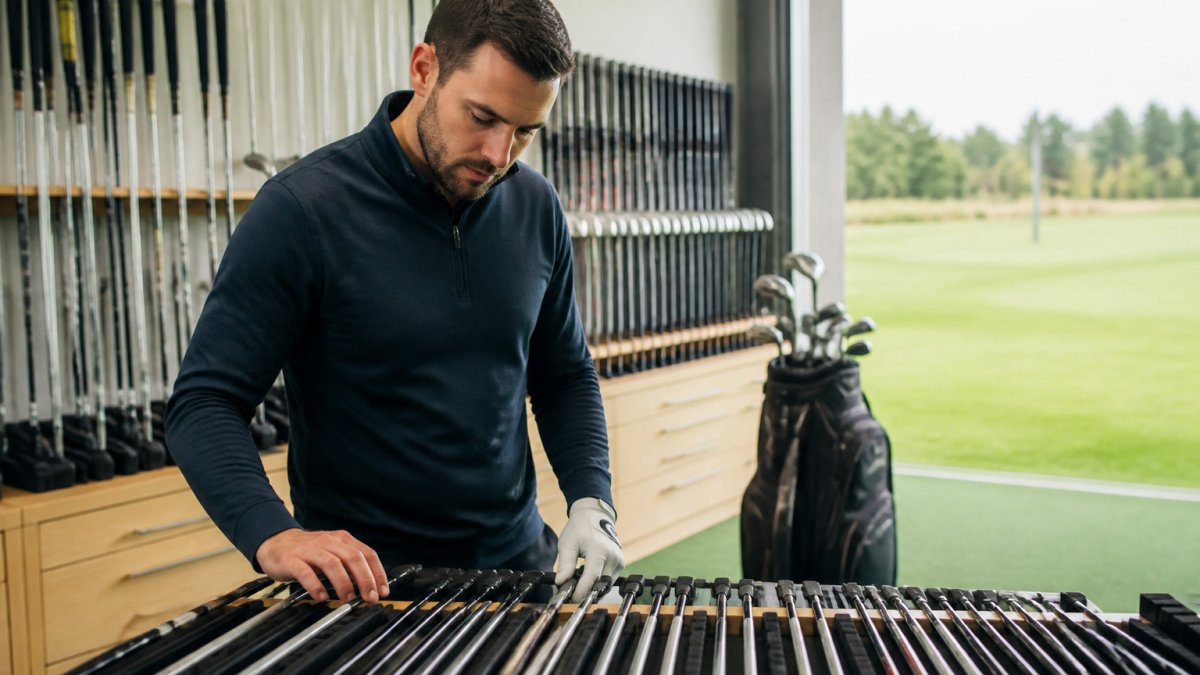
Mid-handicappers typically swing at 75-85 mph with a driver. This usually means regular flex shafts work best. However, "regular" varies dramatically between manufacturers. Some run soft; others run stiff. Without proper fitting data, you're guessing.
Launch monitor technology like Trackman 4 reveals your actual numbers, clubhead speed, ball speed, launch angle, spin rate, and carry distance, showing whether you need a stiffer shaft to reduce spin and lower launch or a more flexible one to increase launch and carry. The difference between right and wrong shaft is often 10-15 yards of carry, significant over 18 holes.
Graphite shafts are lighter and more flexible, producing higher launch and lower spin, ideal for slower swing speeds or maximum distance.
At Major Golf Direct, our PGA Professional staff use Trackman 4 technology in private custom fitting studios to match you with the exact shaft your swing requires. We measure your swing DNA, the unique characteristics of how you swing, and recommend irons and shafts built for your specific numbers, not generic assumptions.
This is where mid-handicappers often gain the most: a proper fitting typically delivers tighter dispersion, more consistent distance, and better course management because you know exactly how far each club travels.
How to Choose the Right Set for Your Game
Start by identifying your swing speed and attack angle: fast and aggressive or smooth and rhythmic, steep or shallow. These determine whether you need maximum forgiveness (Cobra KING MAX, Wilson Dynapower) or a blend of feel and forgiveness (Srixon ZXi5, PXG 0311 P).

Next, consider your priorities. If consistency and distance are paramount, the Wilson Dynapower or Cobra KING deliver excellent value.
Budget matters, but understand what you're trading. At £499, the Wilson Dynapower delivers genuine performance; at £1,049, the Srixon ZXi5 offers superior feel and workability.
Shaft selection is critical. Don't assume regular flex is right for you. Launch monitor fitting reveals whether you need a softer or stiffer shaft, and which shaft material (steel or graphite) optimises your launch angle and spin rate.
Finally, consider durability and resale value. Premium forged irons like the Srixon ZXi5 and PXG hold value better than game-improvement irons.
The right golf iron sets for mid handicappers balance forgiveness with workability, distance with control, and price with performance. Our PGA Professional staff analyse your swing DNA and recommend irons matched to your specific numbers, not generic assumptions. Understanding golf club fitting fundamentals confirms that proper fitting improves consistency and scoring.
Frequently Asked Questions
What should a mid-handicapper look for in an iron set?
Mid-handicappers benefit most from irons that balance forgiveness with workability. Prioritise a lower centre of gravity for higher launch, perimeter weighting to reduce mishit dispersion, and progressive gapping across the set. Custom fitting with Trackman 4 technology reveals your exact swing characteristics—launch angle, ball speed, and attack angle—allowing you to select irons matched to your specific needs rather than guessing.
Are game-improvement irons suitable for mid-handicappers?
Yes. Game-improvement irons offer excellent value for mid-handicappers because they prioritise forgiveness and distance consistency without sacrificing shot shaping ability. Models like the Cobra KING and KING MAX use 3D-printed weight distribution and hollow-body construction. They're designed to help you score better while remaining forgiving on off-centre strikes.
Should mid-handicappers choose cavity-back or players-distance irons?
Mid-handicappers typically perform better with cavity-back or players-distance designs rather than blade irons. Cavity-back irons offer maximum forgiveness and perimeter weighting, while players-distance models like the Srixon ZXi5+ blend forgiveness with refined feel and workability. Players-distance irons suit mid-handicappers with consistent swing mechanics who want tighter dispersion and shot shaping control without sacrificing too much forgiveness.
How far should a mid-handicapper hit a 7 iron?
Most mid-handicappers carry a 7 iron between 160–180 metres, depending on swing speed and launch conditions. Exact distance varies based on clubhead speed, shaft flex, and launch angle. Custom fitting with Trackman 4 measures your actual carry distance and ball flight, helping you establish accurate gapping across your set. This data guides iron selection so each club delivers the distance and trajectory you need for consistent scoring.
What are the best golf irons for a budget?
The Wilson Golf Dynapower range (steel or graphite shaft) offers outstanding value at £499–£599, combining AI-generated variable face technology with low centre of gravity for forgiveness and distance. The Mizuno JPX 925 Hot Metal at £599 delivers 30% improved face technology and excellent speed retention on mishits. Both sets provide game-improvement features and turf interaction quality at mid-range pricing without compromising performance.
